Gate Valve vs Globe Valve: Construction, Selection and Industrial Applications
Ordinary gate valves primarily provide fully open or fully closed pipeline isolation. Globe valves can also isolate, while throttling suitability depends on the trim. Compare construction, pressure loss, flow direction and service conditions before selecting or replacing a valve.

Construction and application notes
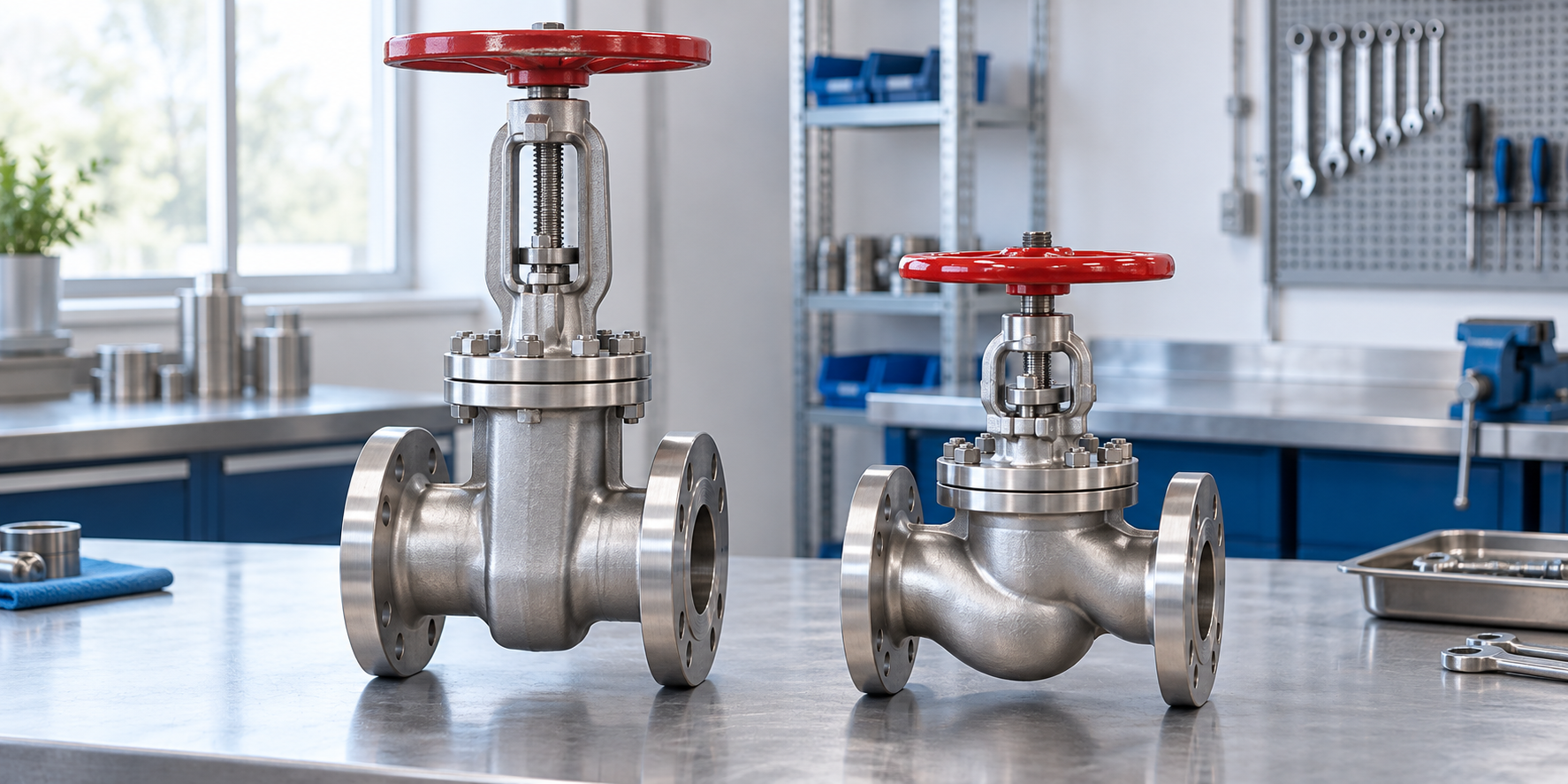
Both valves may have a handwheel, stem and body. Why should a gate valve and a globe valve not be interchanged without a review? Their internal geometry provides the answer: a gate moves out of the flow passage to open the line, while a globe valve changes the opening between its disc and seat.
Start with the duty: pipeline isolation, or flow regulation as well? Then check pressure loss, materials, pressure and temperature. Similar appearance and matching connections do not establish equivalent performance.
Ordinary gate valves primarily provide isolation. Globe valves can also isolate, but suitability for throttling depends on the trim. Matching interfaces do not imply matching pressure loss, sealing or control performance.
01 Construction determines the flow path
A gate moves perpendicular to the flow direction near the seat. A conventional globe valve moves its disc along the seat axis, and the medium changes direction as it passes through the seat. A fully open gate valve generally offers a less obstructed passage; conventional globe valves generally impose more resistance. This comparison does not establish a fixed pressure loss for every model: check the manufacturer's flow coefficient.
[1]Disc-to-seat contact does not guarantee superior sealing
As a globe valve closes, its disc approaches and presses against the seat. Actual leakage depends on sealing materials, manufacturing quality, closing load and test requirements. Valve type alone does not establish zero leakage or better sealing than another design.
For control duty, examine the trim rather than handwheel position
A globe valve suitable for throttling changes flow through the disc-to-seat opening. An isolation-only model may not be suitable for sustained regulation. The fraction of handwheel travel is not the fraction of flow: flow depends on opening characteristics, the medium and differential pressure. Continuous control requires a review of Kv/Cv flow coefficients, the operating range, noise and cavitation.
Do not replace a valve without checking its duty
Replacing an isolation gate valve in a low-pressure-loss water main with a same-size globe valve may increase local resistance. Conversely, a partly open ordinary gate valve is not a substitute for a control valve on a continuously regulated branch. Both designs can shut off flow, but their operating tasks differ.
A restricted opening concentrates the flow and may cause erosion or vibration. KSB's operating instructions explicitly prohibit using gate valves for throttling. Special-purpose designs require their own manufacturer instructions.
[2]02 What should be compared during selection?
| Item | Gate valve | Globe valve |
|---|---|---|
| Main duty | Fully open or fully closed pipeline isolation | Isolation; suitable trim configurations may also regulate flow |
| Closure element | A gate rises out of the flow passage | A disc approaches or moves away from a seat |
| Full-open pressure loss | Generally lower when comparing conventional equivalent designs | Generally higher in conventional turning passages; assess Y-pattern designs separately |
| Sustained throttling | Not suitable for ordinary isolation-only models | Depends on trim and manufacturer-approved service conditions |
| Installation direction | Some designs allow bidirectional flow; follow arrows and instructions for special designs | Check the flow arrow; balanced designs and other configurations may differ |
| Operation and space | Check operating torque and overhead clearance, particularly for large or rising-stem models | Check stem loads due to differential pressure and operator capacity |
| Direct interchangeability | Requires a review of duty and installation requirements | Requires a review of duty and installation requirements |
This is a general comparison, not a specification sheet for a FLINCK model. Isolation and throttling globe valves may use different disc configurations; manufacturer documentation establishes the intended duty.
[3]03 Select valves by their task in the system

A steam or boiler installation may use several valve types. Main-line isolation, equipment maintenance isolation and branch flow control have different requirements. It is incorrect to conclude that steam piping can use only globe valves. Material, pressure-temperature ratings and the specific design determine whether a model is suitable.
For main-line isolation, assess pressure loss
When a valve remains fully open and closes primarily for maintenance, compare an isolation gate valve option. Selection still requires size, flow, pressure, materials and compatibility with the medium. Do not apply the temperature capability of a resilient-seated water valve to steam service.
Define isolation and regulation separately
Distinguish isolation globe valves from throttling models. For automatic, continuous control, evaluate a globe control valve with suitable trim and actuator. Its name alone does not establish control performance.
Assess pressure drop, materials and trim together
Globe control valves are used in feedwater, cooling water, fuel and chemical dosing applications. High-differential-pressure liquid control requires cavitation assessment. Corrosive duty requires a review of wetted materials and seals; a valve type cannot be described as resistant to all acids and alkalis.
04 A practical selection review
- Define the dutyIsolation, intermittent throttling or continuous automatic control?
- Record the service conditionsMedium, temperature, pressure, flow and differential pressure.
- Check the model documentationMaterials, pressure-temperature ratings, trim, flow coefficient and installation direction.
- Confirm installation and operationConnections, face-to-face dimensions, operating space, actuator and maintenance access.
Selection should use the actual operating range, including start-up and other relevant conditions, rather than a single nominal value. Submit the medium, pressure, temperature, flow and connection requirements with the enquiry; confirm model-specific data before replacement.
05 Frequently asked questions
Can gate and globe valves be interchanged?
Not merely because the size and flange dimensions match. Consider replacement only after reviewing duty, pressure-temperature ratings, flow and pressure loss, materials, flow direction, face-to-face dimensions and installation space.
Can a gate valve regulate flow when partly open?
Ordinary isolation gate valves generally operate fully open or fully closed and are not intended for sustained throttling. A restricted opening may lead to erosion, vibration or seat damage. Follow the manufacturer's instructions for special-purpose designs.
Is every globe valve suitable for continuous regulation?
No. Isolation models and throttling-trim models serve different duties. Continuous control also requires a review of flow coefficient, trim, operating range, differential pressure, noise and cavitation.
Must globe valves always have flow entering below the disc?
No universal rule applies. Follow the valve's flow arrow and manufacturer instructions. Balanced-disc configurations and other designs may require a different direction.
Does PN16 mean 1.6 MPa is allowed at every temperature?
No. PN is a nominal pressure designation. Allowable pressure depends on material, design standard and temperature. Consult the model's pressure-temperature rating table instead of treating the designation as a universal operating pressure.
References and technical basis
Prepared using publicly available manufacturer documentation. General explanations do not replace the instructions for a specific model. References reviewed on 11 October 2026.